

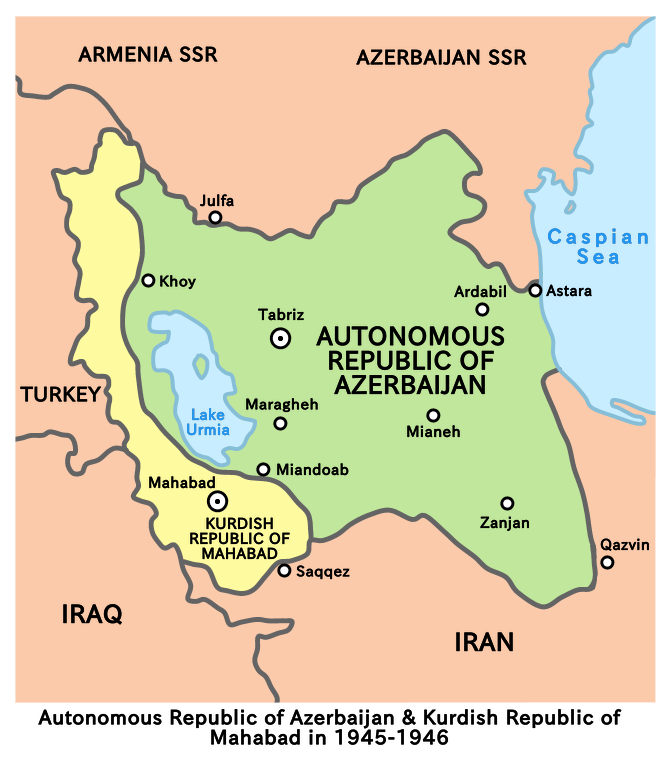
The Republic of Mahabad was declared on 22 January 1946 in the city of Mahabad (also known by its older name, Sauj Bulaq), in what is now northwestern Iran. It survived for eleven months before collapsing in December of that year. By any measure, eleven months is a short time to build a state. What makes Mahabad remarkable is how much those eleven months actually produced, and how far the memory of that republic has travelled in the decades since.
How it came to exist
The republic emerged from a particular moment in modern history. During the Second World War, Soviet and British forces had occupied different zones of Iran to prevent it from falling under German influence. In the Soviet-controlled northwest, Kurdish political organisation became possible in a way it had not been before. The Kurdish Democratic Party of Iran, known by its Kurdish initials KDPI, was founded in Mahabad in 1945, and its leader Qazi Muhammad became the president of the republic when it was proclaimed the following January.
The republic covered a relatively small area, centred on Mahabad and the surrounding region of eastern Kurdistan, known in Kurdish as Rojhilat. It was never internationally recognised. Its existence depended in part on a fragile relationship with Soviet support, and when that support was withdrawn as part of broader postwar negotiations, the republic’s position became very difficult very quickly. Iranian government forces entered Mahabad in December 1946. Qazi Muhammad was arrested and later executed in the city’s main square. The republic was over.

What the republic built
What is striking, looking back, is the speed and ambition of what the republic attempted. Kurdish was made the official language of government, courts and education. Schools were opened that taught in Kurdish, which was not a small thing at a time when Kurdish-language education was suppressed across much of the region. A printing press was established and began producing Kurdish-language books and newspapers. For many Kurds in the area, this was the first time they had seen their language in print as a language of public life rather than something confined to oral tradition and private use.
The republic also formed its own military force. A significant figure here was Mustafa Barzani, the Kurdish commander from the Bashur region (what is now the Kurdistan Region of Iraq), who brought several hundred fighters across the border to support the republic. After its fall, Barzani and his forces could not safely return south and instead made a long and difficult journey northward into the Soviet Union, where they remained in exile for over a decade. Barzani would later return to lead the Kurdish movement in Iraq, and his connection to Mahabad became part of his political biography.
Culture and memory
Beyond institutions, the republic produced something harder to quantify but just as important: a sense that a Kurdish public life was possible. Poets and musicians gathered in Mahabad during those months. The city had already been a centre of Kurdish literary culture, and the republic gave that culture a political frame. Kurdish identity was not just something to be expressed in private; it was something a government could be built around.
The memory of the republic has been carried forward in different ways. In Iran, public commemoration has not been possible, but among Kurds in the diaspora and in other parts of Kurdistan, Mahabad is remembered as proof that Kurdish self-governance is not an abstract wish but something that was actually done, however briefly. Qazi Muhammad’s name is widely known across all four parts of Kurdistan. The KDPI, though it has gone through many changes over the decades, traces its origins directly to that moment.
At Kurdistan.fm, we cover the stories that connect Kurds across borders and across generations. The Republic of Mahabad is one of those stories. If you have family memories connected to Mahabad or to the Kurdish movement in Rojhilat, we would love to hear from you.