

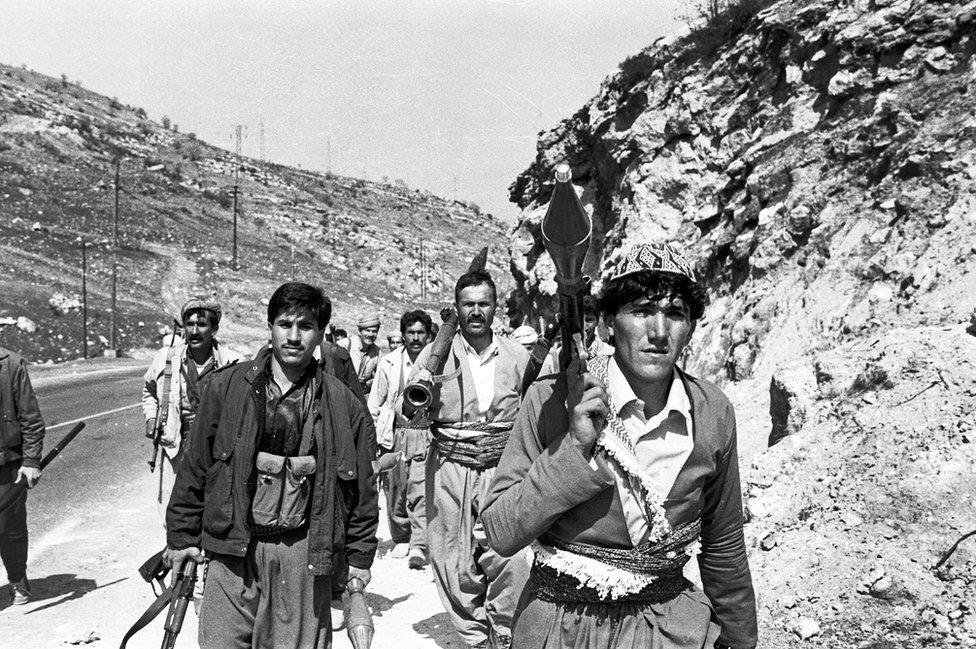
The early 1990s brought something that had seemed impossible for generations: a large piece of Kurdish territory in northern Iraq that was, for the first time, largely free from Baathist control. After the Gulf War of 1991, a no-fly zone protected by the United States and its allies kept Saddam Hussein’s forces out of much of the Kurdish north. It should have been a moment of building. For a few years, it was. Then, in 1994, the two most powerful Kurdish factions turned on each other, and the Kurdish civil war of the 1990s began.
Two parties, one region
To understand what happened, you need to know the two main players. The Kurdistan Democratic Party, known as the KDP, was founded by Mustafa Barzani in 1946 and had its stronghold in the Badinan region around Duhok (Dohuk) and the city of Hewlêr (Erbil). The Patriotic Union of Kurdistan, the PUK, was founded by Jalal Talabani in 1975 and drew its support mainly from Sulaymaniyah (Silêmanî) and the surrounding areas to the south and east. The two parties had clashed before, briefly, in the late 1970s. But after the horrors of the Anfal campaigns and the chemical attack on Halabja in 1988, they had managed to cooperate, even holding joint elections in 1992. Those elections produced a near-perfect tie and a fragile power-sharing arrangement. The arrangement did not hold.
By 1994, disputes over territory, customs revenue and political authority had broken into open fighting. The conflict that followed lasted, with periods of ceasefire and renewed violence, until 1998. Both sides committed serious abuses. Both sides also sought outside help: the KDP at one point accepted military assistance from Saddam Hussein’s government, a decision that still provokes strong feelings. The PUK had connections with Iran. The war drew in regional powers in ways that made it harder, not easier, to stop.

What the fighting cost
The human cost was heavy. Thousands of people were killed, many of them civilians caught between factions or displaced from their homes. The city of Hewlêr changed hands more than once. Families in some areas were effectively divided by front lines. The region that had just escaped one nightmare found itself inside another, and the outside world largely looked away.
Economically, the damage was severe. The informal arrangements that had kept trade and government functioning after 1991 broke down. Infrastructure that had barely recovered from the Baathist period was damaged again. The two administrations that emerged, one KDP-controlled and one PUK-controlled, ran parallel governments in their respective zones, a situation that continued for years even after the fighting stopped.
The Washington Agreement and its aftermath
The ceasefire that finally took hold came through American mediation. In 1998, representatives of the KDP and PUK signed the Washington Agreement, committing to a lasting peace, the sharing of revenues and an eventual reunification of their administrations. Progress was slow and deeply uneven, but the shooting largely stopped.
Reunification of the two administrations did not happen until 2006, when a unified Kurdistan Regional Government, the KRG, was formally established in Hewlêr. By then, the political landscape had changed dramatically: Saddam Hussein’s government had fallen in 2003, and Kurdish forces had played a significant role in the events that followed. The civil war years came to be seen by many Kurds as a painful and avoidable detour, a period when internal division cost the Kurdish cause dearly at a moment when history was, briefly, offering something different.
The memory of those years has not faded. It shapes how Kurdish political parties talk to each other, how ordinary people in Sulaymaniyah and Hewlêr think about unity and rivalry, and how the diaspora understands the distance between Kurdish solidarity as an idea and Kurdish politics as a reality. If you have your own memories of that period, or family stories from those years, we would be glad to hear them at Kurdistan.fm.