

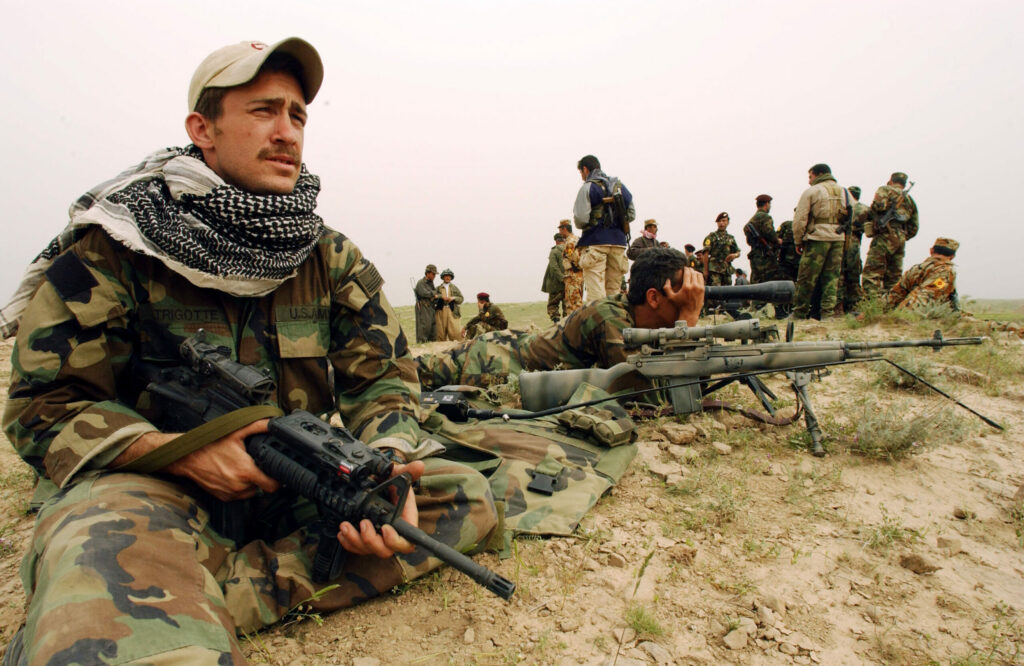
When American and British forces invaded Iraq in March 2003, the Kurds of Bashur (Iraqi Kurdistan) were already organised, already armed, and had been governing themselves for over a decade. The war brought them into a partnership that would reshape the region and, above all, change the legal and political standing of the Kurdish people in Iraq for a generation.
A decade of self-rule before the war
The context matters. After the Gulf War of 1991, a no-fly zone imposed by Western powers over northern Iraq allowed the Kurdistan Regional Government, known as the KRG, to take root. The two main parties, the Kurdistan Democratic Party (KDP) led by Masoud Barzani and the Patriotic Union of Kurdistan (PUK) led by Jalal Talabani, had fought bitterly against each other during the mid-1990s in a civil conflict that left deep scars. By 1998 they had reached an uneasy peace, and by 2003 both were administering their respective zones with functioning, if imperfect, institutions.
This meant that when the war began, the Kurds were not passive observers. They had experienced military forces, the Peshmerga, whose name means roughly those who face death. They had political structures capable of negotiating with Washington. And they had grievances against Saddam Hussein’s government that needed no exaggeration: the Anfal campaign of the late 1980s had destroyed thousands of villages and killed very large numbers of Kurdish civilians, and the chemical attack on Halabja in 1988 remained an open wound.

The Kurdish role in the fighting
The original American plan had included a northern front, with tens of thousands of troops advancing through Turkey. When the Turkish parliament voted in March 2003 not to allow that, the plan shifted. American special operations forces worked alongside the Peshmerga in the north, and Kurdish fighters became the primary ground force in that part of the country.
Kirkuk (Kerkûk in Kurdish), the oil-rich city that Kurds consider a historic part of their homeland but that successive Iraqi governments had Arabised through deliberate resettlement, fell to Peshmerga forces in April 2003. The scene was celebrated in the Kurdish regions and viewed with alarm by Turkey, which had long worried about Kurdish territorial gains near its border. The status of Kerkûk became one of the most charged unresolved questions of the post-war period, one that remained deeply contested for years afterward.
In the north, Mosul (Mûsil) also passed quickly, with Kurdish forces moving into the city while the regular Iraqi army collapsed. The speed of events meant that borders between Kurdish-controlled and Arab-controlled areas were redrawn on the ground rather than at a negotiating table, creating disputes that would outlast the war by many years.
What the war produced for the Kurds
The new Iraqi constitution, passed by referendum in 2005, formally recognised the Kurdistan Region and gave it a degree of federal autonomy unlike anything that had existed before in Iraqi law. Jalal Talabani became President of Iraq, the first Kurd to hold that office, a fact that carried enormous symbolic weight across all parts of Kurdistan and the diaspora.
The KRG used the following years to attract foreign investment, develop its oil industry and build infrastructure in Hewlêr (Erbil), Silêmanî (Sulaymaniyah) and Duhok. The region became notably more stable than much of the rest of Iraq during a period of severe sectarian violence further south.
Yet the gains were also complicated. The question of Kerkûk was never resolved through the constitutional mechanism that had been promised. The relationship between Hewlêr and Baghdad remained tense over budgets and oil revenues. And the surge of armed groups across Iraq during the years that followed the invasion created dangers that would eventually land on Kurdish doorsteps too, most dramatically with the rise of ISIS in 2014.
How the war is remembered
Among Kurds, the memory of 2003 is genuinely mixed. Many feel that the fall of Saddam and the constitutional gains that followed represented a turning point after decades of catastrophic repression. Others point to the instability the war unleashed across the region and the unfinished promises around Kerkûk. The Peshmerga’s role is generally a source of pride, though the parties behind them are subjects of ongoing political debate inside the Kurdish community itself.
Outside Kurdistan, the war remains one of the most contested episodes in recent international history, and Kurdish participation in it has been read very differently depending on who is doing the reading. What is harder to dispute is that the legal and political landscape of Bashur after 2003 was transformed in ways that would have seemed extraordinary to anyone watching the Anfal fifteen years earlier.
If you have memories of 2003, from the region or from the diaspora, we would love to hear them. Get in touch through our website or social media, and tune in to Kurdistan.fm for music, news and culture from across all four parts of Kurdistan.