

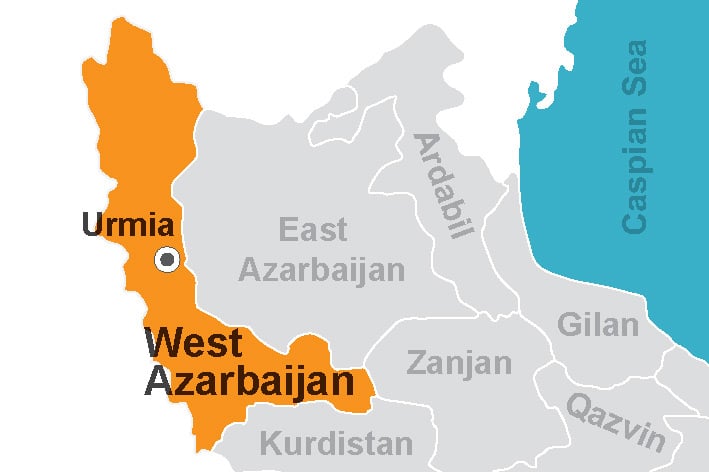
Urmiye (Urmia in Persian, sometimes spelled Orumiyeh) sits on the western shore of Lake Urmiye in the Iranian province of West Azerbaijan, not far from the borders of Turkey and Iraq. It is one of the largest cities in northwestern Iran, and for centuries it has been home to a mixed population of Kurds, Azerbaijani Turks, Assyrians, Armenians and others. The Kurds of West Azerbaijan are among the less-discussed communities in the wider Kurdish world, yet their presence in this region is deep-rooted, and their cultural life is worth knowing.
A city between mountains and a shrinking lake
Lake Urmiye was once one of the largest saltwater lakes in the world. It gave the city its character and its economy, and it still dominates the landscape, though the lake has contracted sharply in recent decades due to damming, irrigation and drought. The city itself is surrounded by fertile plains where fruit orchards have long been famous, particularly apples and grapes.
Urmiye has been continuously settled for thousands of years. It appears in ancient sources and was an important town under Median, Parthian and later Islamic rule. By the time of the great Kurdish dynasties of the medieval period, the surrounding region already had a well-established Kurdish population. The Mukri tribe and other Kurdish groups have historically been concentrated in the areas east and south of the lake, with the city of Mahabad (the subject of a separate article on this site about the short-lived Republic of Mahabad) lying to the southeast. Urmiye itself sits at the northern edge of this Kurdish zone, which is why its population has always been ethnically mixed.

Kurdish life in a mixed province
The Kurds of West Azerbaijan speak primarily Sorani, the same dialect group used across much of Iranian Kurdistan and the Kurdistan Region of Iraq. In some villages around Urmiye, Kurmanji speakers can also be found, reflecting the proximity of the Turkish and Iraqi borders where Kurmanji is more widely spoken.
Kurdish cultural life in the province has faced significant pressure over the decades. Like Kurds elsewhere in Iran, those in West Azerbaijan have at various times been restricted in publishing, broadcasting and teaching in their language. Despite this, oral traditions have remained strong. Folk poetry, local music and the storytelling traditions associated with the dengbêj (the Kurdish oral poet-singers who preserved history and memory through song) have continued in homes and at gatherings even when public expression was limited.
The music of the Urmiye region carries its own local colour. The instruments, the scales and the style of singing reflect the meeting point of Kurdish, Azerbaijani and wider Iranian musical influences. This cross-pollination is audible rather than theoretical. If you listen to traditional music from this area, you hear something that belongs clearly to Kurdish tradition and yet has absorbed sounds from its neighbours over centuries of shared geography.
The Christian communities and their legacy
Urmiye is also significant in the history of Assyrian and Armenian Christians, communities whose presence in the region long predates the modern state borders. The city was a centre of Assyrian cultural and religious life, and it attracted American and European missionaries from the nineteenth century onwards, which is partly why it has a relatively well-documented history in Western archives. The violence of the First World War period devastated these Christian communities across the region, and Urmiye lost a large part of its Assyrian and Armenian population as a result. The Kurdish, Azerbaijani and other Muslim populations that remained found themselves in a changed city.
This history matters for understanding the Kurds of West Azerbaijan, because it shaped the demographic landscape they inhabit and because relations between communities, complicated by that period, have been part of the region’s social memory ever since. Today, small Assyrian and Armenian communities remain in Urmiye, and their churches are still standing.
Connections to the wider Kurdish world
The Kurds of West Azerbaijan are connected to the broader Kurdish world in ways that go beyond geography. Many families from the Urmiye region have relatives in the Kurdistan Region of Iraq, in Turkey and in the diaspora in Europe and North America. Migration, whether driven by economic need or political circumstances, has spread people from this area widely.
At the same time, there is a strong local attachment to the landscape of West Azerbaijan itself. The mountains, the orchards, the shore of the lake and the particular mix of peoples that the region contains are all part of how people from Urmiye understand where they come from. Kurdish identity here does not exist in isolation. It coexists, sometimes easily and sometimes with friction, alongside other identities that share the same land.
If you have family from Urmiye or the surrounding villages, or if you know music, stories or memories connected to this part of Rojhilat (Iranian Kurdistan), we would love to hear from you at Kurdistan.fm. The voices from the northwest are part of the full picture of Kurdish life, and they deserve to be heard.