

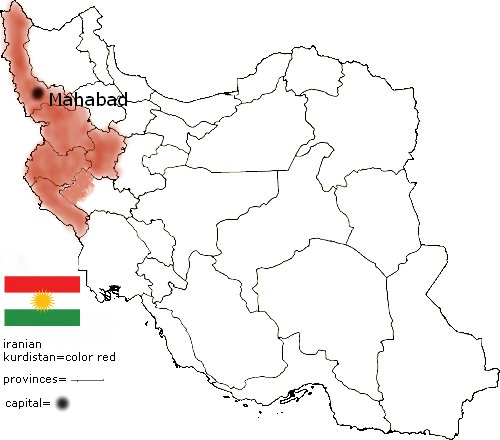
Rojhilat, meaning roughly “the east” in Kurdish, is the name Kurds use for the Kurdish-populated regions of western Iran, stretching from the mountains along the Iraqi border northward toward Azerbaijan and southward toward Ilam. It is the largest of the four parts of Kurdistan by population, home to many millions of Kurds, yet it is often the least visible to outside audiences. That invisibility has nothing to do with what the region offers. Rojhilat Kurdistan has its own cities, its own literary traditions, its own musical character and an identity that has been quietly insisting on itself for centuries.
Cities and landscapes
The best-known city in Rojhilat is Sine (Sanandaj), the capital of Kurdistan Province in Iran and a place of genuine cultural weight. Sine has a reputation across all four parts of Kurdistan for producing fine poets, musicians and craftspeople, and the city’s old bazaar, its traditional houses and its distinct architectural character have made it something of a reference point for Kurdish urban life in Iran. Further north lies Kirmanşah (Kermanshah), one of the largest cities in western Iran, with a Kurdish and Persian-speaking population and a history stretching back to antiquity. The rock reliefs at nearby Bisotun, where ancient inscriptions were carved into a cliff face, are among the most remarkable ancient monuments in the entire region. Mahabad (Mehabad) sits in the northwest of Rojhilat and carries a special place in Kurdish political memory as the site of the short-lived Kurdish republic of 1946. Ilam Province in the south, sometimes overlooked, rounds out a region of considerable geographic variety, from high mountain valleys to warmer lowland plains.
Language and literature
Most Kurds in Rojhilat speak Sorani, the central Kurdish dialect also widely spoken across the border in Bashur (the Kurdish region of Iraq). In the south, around Kirmanşah and Ilam, Gorani and its related varieties have historically been spoken, and these older forms of Kurdish have their own literary and religious traditions. Sorani has a strong written tradition, but in Iran its use in schools and official contexts has been severely restricted for most of the past century. Despite this, writers, poets and journalists in Rojhilat have continued producing literature in Kurdish. Kurdish publishing has at times moved underground, into exile, or onto digital platforms, but the output has not stopped. The region produced a remarkable body of poetry in the twentieth century, often circulated through handwritten copies or cassette recordings before reaching a wider audience.

Music from the mountains
Rojhilat has a distinct musical sound that anyone who has spent time with Kurdish music will recognise. The tanbur, a long-necked lute with deep spiritual associations in the Yarsan tradition, is closely identified with the Kurdish communities of this region. The kamancheh, a spike fiddle played with a bow, has also flourished here, carried by players whose improvisational style is inseparable from the landscape and the poetry it accompanies. Vocalists from Rojhilat have had an outsized influence on Kurdish music more broadly. Wedding songs, laments, devotional music and classical-style compositions all exist alongside each other in the region’s musical life. Much of this music has been preserved by diaspora communities in Europe and North America, who recorded and distributed cassettes and later digital files so that the sound would not be lost.
Living with difficulty, keeping culture alive
Kurdish cultural life in Rojhilat has faced persistent legal and political restrictions under successive Iranian governments. Kurdish-language education, broadcasting and publishing have been tightly controlled, and Kurdish political activity has been treated harshly at various points in recent decades. These are plain facts, widely documented by journalists and human rights organisations. Within that context, the culture has continued. Families pass language on at home. Musicians play at private gatherings. Poets publish through diaspora presses and online. The diaspora community, spread across Europe and beyond, has played a significant role in keeping Rojhilat’s cultural production in circulation and in connecting younger generations to it. The links between Kurds in Rojhilat and those elsewhere have been maintained through music as much as through anything else.
At Kurdistan.fm, Rojhilat’s music and voices are part of what we broadcast every day. If you have memories, recordings or stories from the Kurdish east that you think deserve a wider audience, we would love to hear from you.