

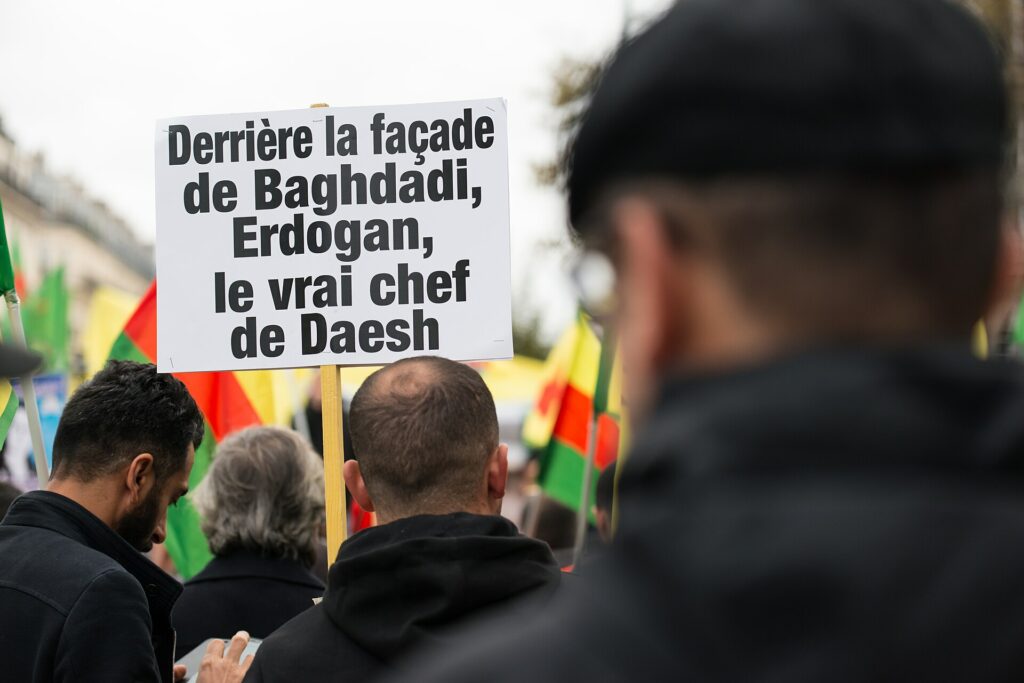
Photograph: Jan Maximilian Gerlach, CC BY-SA 2.0
Rojava, the Kurdish name for the western part of Kurdistan, covers a wide stretch of northern Syria along the Turkish border. The word simply means “west” in Kurmanji Kurdish, the main language spoken there. For much of the twentieth century, the Kurds of this region lived under Syrian state policies that restricted their language, limited land ownership and, in some areas, denied citizenship to long-established communities. Then the Syrian civil war, which broke out in 2011, remade the entire region almost overnight. As the Syrian government withdrew from large parts of the north, Kurdish political and military organisations moved to fill the space, and the Rojava autonomous region as it is known today began to take shape.
Three cantons, one project
Rojava is often described through its three main cantons: Cizîrê (Jazira) in the east, Kobanê (Kobane) in the centre, and Efrîn (Afrin) in the west. Each has its own character. Cizîrê is the largest and most ethnically mixed, home to Kurds, Arabs, Assyrian Christians, Armenians and others. Kobanê became internationally known after a prolonged siege by the Islamic State group in 2014 and 2015, when its defence by Kurdish forces was watched closely around the world. Efrîn, surrounded by olive groves and mountains, came under the control of Turkish-backed forces in 2018, displacing a large part of its Kurdish population. That displacement remains a deeply painful subject for Kurds everywhere, and the situation in Efrîn continues to be contested and unresolved.
The political structures of Rojava were built around the ideas of a movement led by the Democratic Union Party, known by its Kurdish initials PYD. The system they put in place, sometimes called democratic confederalism, emphasises local councils, co-leadership between men and women at every level of administration, and the participation of different ethnic and religious communities. Supporters see it as a practical and original form of grassroots democracy. Critics, including the Turkish government and some Kurdish political groups, dispute its methods, its relationship to the PKK (the Kurdistan Workers’ Party active in Turkey), and the degree to which it represents the full range of opinion in the region. These debates are genuine and ongoing.

A society of many communities
One of the most striking things about Rojava, to outside observers, is the range of peoples who have lived there for centuries. Alongside the Kurdish majority, the region has significant Arab communities, Syriac-speaking Christians who trace their presence back to antiquity, and smaller groups of Armenians and Yazidis. The Syriac Christians in particular have maintained their own militias, schools and cultural institutions within the autonomous administration, a fact that reflects both the complexity of the region and the negotiated nature of its governance.
Qamişlo (Qamishli), the largest city in Cizîrê and the closest thing Rojava has to an administrative capital, gives a good sense of this layering. It sits on the Syrian-Turkish border, directly opposite the Turkish town of Nusaybin, which is itself a predominantly Kurdish town. The two sides of the border share a history, a language and in many cases family connections, even as they have lived under entirely different states for nearly a century. Qamişlo has long had Kurdish, Arab, Armenian and Assyrian neighbourhoods, and its markets and streets reflect that mix.
Culture and language in a contested space
The years of Syrian state restrictions left a particular mark on Kurdish cultural life in Rojava. Public use of the Kurdish language was suppressed for decades. Schools taught in Arabic only. After 2012, Kurdish-language education became available for the first time in living memory for many families, and that change has had a profound emotional weight for communities who had kept their language alive at home while being forbidden to use it publicly.
Music has always been central to Kurdish life in this region. The dengbêj tradition of oral singing, in which epic stories and laments are passed from singer to singer across generations, has deep roots in the Cizîrê area in particular. The poet Cegerxwîn, one of the most beloved figures in Kurmanji literature, was born in this region and spent much of his life writing about its landscapes and its people. His work is still recited and set to music by artists across the diaspora.
The women’s movement that emerged within Rojava’s political structures also produced its own cultural expressions, from music and film to literature. Women’s councils, women’s academies and an all-female military force called the YPJ (Women’s Protection Units) became some of the most discussed aspects of the Rojava experiment internationally, drawing both admiration and scepticism depending on the source.
Listening from a distance
For Kurds in the diaspora, Rojava carries a particular weight. Many families left the region decades ago, pushed out by poverty, repression or conflict, and have watched events there from cities in Europe, North America and Australia with a mixture of pride, grief and anxiety. The culture they carried with them, the Kurmanji songs, the New Year celebrations, the stories of their grandparents’ villages, connects directly to the landscapes of northern Syria even when those landscapes are no longer accessible to them.
At Kurdistan.fm, we broadcast music and voices from all parts of Kurdistan, including Rojava. If you have a story, a song or a memory connected to this region, we would love to hear from you.