

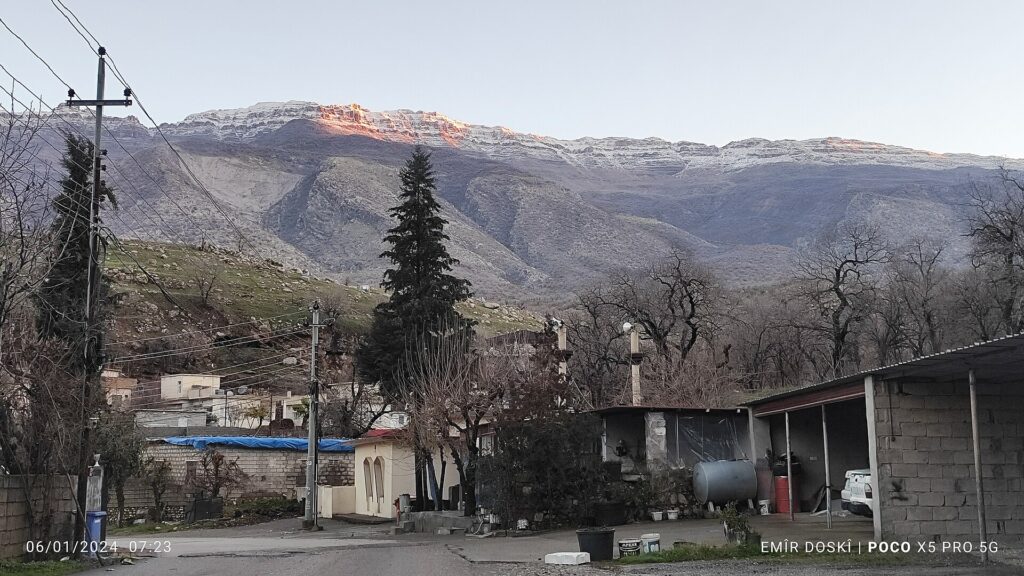
Photograph: Emir Doski, CC BY-SA 4.0
Few families in modern Kurdish history carry as much weight as the Barzanis. For nearly a hundred years, the name has been tied to the Kurdish national movement in Bashur (the part of Kurdistan that falls within present-day Iraq), from the mountain rebellions of the early twentieth century through to the semi-autonomous region that exists today. Understanding the Barzanis means understanding much of how that movement grew, fractured and endured.
Şêx Mehmûd and the world Mustafa Barzani entered
When Mustafa Barzani was born in the village of Barzan in the late 1900s, Kurdish leaders had already spent decades pressing the case for self-determination. The collapse of the Ottoman Empire had raised hopes, and then the Treaty of Lausanne in 1923 closed the door on any internationally recognised Kurdish state. Into this frustrated landscape came Mustafa Barzani, a man from a family that already commanded deep loyalty in the Barzan region of what is now the Kurdistan Region of Iraq.
Mustafa Barzani led or participated in several uprisings against the Iraqi government from the 1930s onwards. None succeeded in their immediate aims, and he spent long years in exile, including more than a decade in the Soviet Union after the collapse of the Republic of Mahabad in 1946, the short-lived Kurdish state in what is now Iran. He returned to Iraq in the early 1960s and led the peshmerga, the Kurdish armed fighters, through years of guerrilla warfare in the mountains of the north.

The Kurdistan Democratic Party and the long armed struggle
In 1946, while still in Mahabad, Mustafa Barzani became a founding figure of the Kurdistan Democratic Party, known by its Kurdish initials as the KDP. The party would become the primary vehicle for Barzani-led politics in Bashur, and it remains one of the two dominant political forces in the Kurdistan Region today.
The armed struggle of the 1960s and early 1970s drew wide attention. A peace agreement known as the March Manifesto was signed in 1970 between Barzani and the Baghdad government, promising a degree of autonomy. The agreement broke down, and fighting resumed. When the uprising collapsed in 1975, following the Algiers Agreement between Iraq and Iran which cut off crucial Iranian and American support, Mustafa Barzani went into exile again. He died in the United States in 1979, without seeing the goals he had spent his life pursuing.
The KDP split in the mid-1970s, and the Patriotic Union of Kurdistan, the PUK, was founded by Jalal Talabani in 1975. The two parties would become rivals as well as occasional allies, a division that reflected genuine differences in politics, geography and clan loyalty. Talabani drew much of his support from the Sulaymaniyah area in the south-east of Bashur, while the KDP remained strongest in the north and west, particularly around Hewlêr (Erbil) and Duhok.
Masoud Barzani and the road to autonomy
Mustafa Barzani’s son Masoud took on the leadership of the KDP and guided it through some of the most difficult decades in Bashur’s history. The 1980s brought the Anfal campaign, in which the Iraqi government carried out mass killings and the destruction of thousands of villages across Kurdish areas. The chemical attack on Halabja in 1988 was the most documented single event of that campaign. The Barzanis, like most Kurdish political leaders, lost family members and community in those years.
After the Gulf War of 1991, a no-fly zone protected much of Bashur from Baghdad’s forces, and a Kurdish administration began to function on the ground for the first time. The KDP and PUK fought a painful civil conflict in the mid-1990s before reaching a ceasefire and eventually a power-sharing arrangement. The fall of Saddam Hussein’s government in 2003 opened a new chapter. The Kurdistan Regional Government, the KRG, gained formal recognition within the Iraqi constitution of 2005, and Masoud Barzani served as its president for a number of years.
A family, a symbol and a complicated legacy
The Barzani name is, for many Kurds, a symbol of continuity and sacrifice. For others, particularly those who support rival parties or who have experienced the KDP’s exercise of power at close quarters, the family represents a concentration of political and economic influence that raises harder questions. Both things can be true at once, and Kurdish public life contains both views.
Masrour Barzani, Masoud’s son, became Prime Minister of the Kurdistan Region and has played a central role in its government in recent years. The family’s presence across three generations of leadership is unusual by any measure, and it ensures that the Barzani story is still unfolding rather than complete.
At Kurdistan.fm we cover the politics, history and culture of all four parts of Kurdistan and the diaspora. If the story of the Barzanis and the Kurdish national movement connects to your own family history, we would love to hear from you.